

InnoTrans 2026: Four days at the trade show & plenty of inspiration
Four days full of energy and concrete solutions for public transportation
From September 22 to 25, the international mobility industry gathered at the 30th InnoTrans in Berlin.
For transportation companies, one key question stood out: How can vehicles, energy, personnel, and infrastructure be integrated in such a way that operations remain reliable even as complexity increases?
Our focus was on open dialogue with users, customers, partners, and prospective clients. Together, we discussed how transportation companies can better integrate their operational processes and address specific day-to-day challenges in a more proactive manner.
The 30th-anniversary edition underscored the importance of InnoTrans as a gathering place for the industry. According to the final report from Messe Berlin, 175,591 trade visitors from 128 countries came to Berlin. 3,190 exhibitors from 59 countries presented their solutions; in addition, there were 180 world premieres. The organizers also reported high levels of satisfaction among exhibitors and trade visitors.
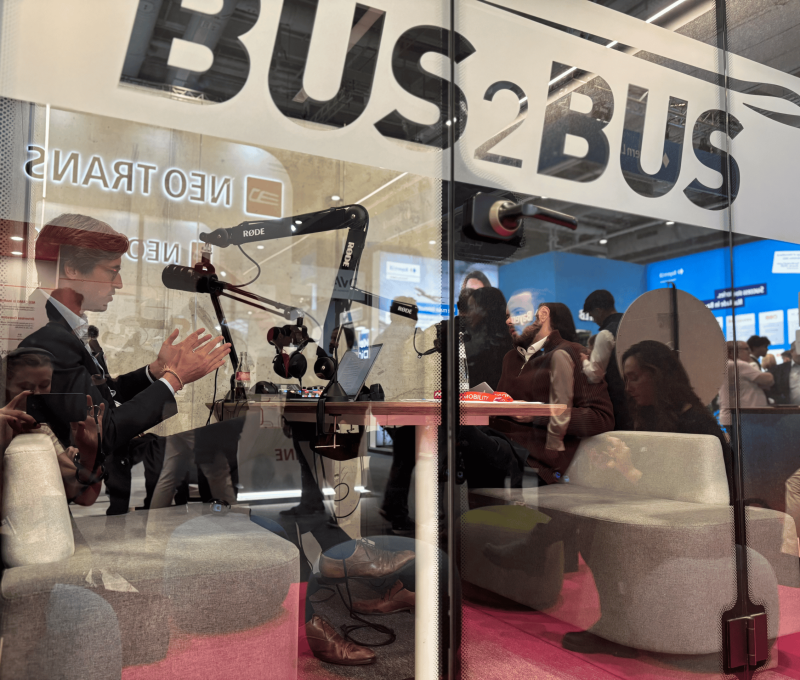
This international reach was also evident at our booth in Hall 2.1. People with different roles and perspectives were united by the desire to reliably organize mobility – even in the context of electric fleets, connected processes, and increasing demands for safety and efficiency.
The trade show gave us the opportunity to better understand requirements and discuss practical next steps. It was particularly valuable that overarching topics related to the future could be quickly applied to day-to-day operations.
Predictive Dispatching: From a Single Route to the Entire Activity Chain
A key focus of our trade show presentation was Predictive Dispatching, an extension of our PEAK.DMS depot management system. Rather than simply considering the next vehicle assignment, the solution links multiple routes into a chain of activities and checks whether a vehicle can complete them under the planned conditions throughout the entire workday.
The system takes into account the charge level, charging window, available charging stations, charging breaks, and parking locations. If the charge level is at risk of falling below the defined reserve, PEAK.DMS can suggest an alternative vehicle.
The assignment remains visible to the control center at all times and can be adjusted as needed. A simple example illustrates why this view beyond the next route is important: An electric bus may be sufficiently charged for a single trip. However, if it is subsequently scheduled for additional routes, there may not be a suitable charging window, or it may not be where it needs to be in the evening for its first assignment the following day. An isolated, individual decision can thus complicate subsequent operations. Predictive dispatching makes such interdependencies visible earlier and helps coordinate vehicle assignment, charging, and parking.
The extension integrates electric, hybrid, and diesel vehicles into a common scheduling framework and evaluates their suitability for the respective activity chain. The appropriate solution depends on the fleet structure, route planning, and operational conditions.
The discussions at InnoTrans confirmed the importance of this connection: In addition to the powertrain, electric mobility is also changing how routes, charging times, parking areas, and operational readiness are planned.
A portfolio for interconnected business processes
At the booth, we positioned Predictive Dispatching within our broader portfolio of solutions. PEAK.DMS supports the digital management of depot processes—from parking, refueling, and maintenance to vehicle deployment—and consolidates operational information for this purpose.
With PEAK.ITCS, we presented solutions for route planning and operations control. For workforce planning and scheduling, we showcased PEAK.PROFAHR as well as the next-generation PROFAHR.X, featuring an enhanced user interface and AI-based interaction.
In addition, the discussion focused on cybersecurity for critical operational environments: control, storage, and planning systems must not only be high-performance but also protected against growing digital risks. With Cybersense, we showcased an expanded cybersecurity portfolio from the Altamount family.
Productive discussions, concrete results
The success of a trade show appearance is measured by whether the interactions lead to professional exchanges and opportunities for collaboration. At the trade show, we discussed current challenges with customers, partners, and prospective clients and explained our approaches using specific application scenarios.
The discussion focused on questions that concern many transportation companies: How can vehicles be reliably scheduled across multiple routes? How can loading processes be better integrated with route and parking planning? And how can operational information be consolidated so that control centers can make faster and more informed decisions?
Der direkte Dialog liefert wichtige Impulse für die Weiterentwicklung digitaler Mobilitätslösungen. Er ersetzt keine detaillierte Analyse der Betriebsabläufe, hilft aber, Anforderungen früh zu klären und geeignete Einsatzfelder zu identifizieren. So wirken Produktpräsentationen über die Messetage hinaus.
What are we taking away from the trade show?
The main insight we take away from InnoTrans 2026 is this: Transit agencies need solutions that don’t view vehicles, energy, personnel, and operations in isolation, but rather make their interconnections understandable and manageable.
That is why we continue to develop our software with a focus on real-world applications and consistently tailor our innovations to business needs. The feedback and questions we receive from Berlin provide important guidance in this regard.
Conclusion: A dialogue that leads to further progress
InnoTrans 2026 served as a successful starting point for new projects for Peak Mobility. The well-attended booth and the positive feedback from industry professionals demonstrated just how valuable in-person interaction is for developing concrete solutions.
Thank you to everyone who visited us in Hall 2.1 and shared their perspectives with us. We look forward to continuing this dialogue.
Would you like to learn more about predictive dispatching?
How can transit agencies plan their e-bus fleets more proactively? In the white paper “Predictive Dispatching: From Reacting to Planning Ahead,” you’ll learn, through real-world examples, how predictive dispatching can help. A checklist also helps you evaluate potential areas of application for system expansion.
Request the white paper now!
